Archive Page 30

Combining ASM and NAS. Got Proof?

I blogged yesterday about Oracle over NFS performance and NFS protocol for Oracle. In the post I referenced a recent thead on comp.databases.oracle.server where Oracle over NFS performance was brought into question by a list participant. I addressed that in yesterday’s blog entry. The same individual that questioned Oracle NFS performance also called for proof that Oracle supports using large files in an NFS mount as “disks” in an ASM disk group. I didn’t care to post the reply in c.d.o.s because I’m afraid only about 42 people would ever see the information.

Using ASM on NAS (NFS)
I’ve blogged before about how I think that is a generally odd idea, but there may be cases where it is desirable to do so. In fact, it would be required for RAC on Standard Edition. The point is that Oracle does support it. I find it odd actually that I have to provide a reference as evidence that such a technology combination is supported. No matter, here is the reference:

Oracle Documentation about using NAS devices says:

C.3 Creating Files on a NAS Device for Use with Automatic Storage Management

If you have a certified NAS storage device, you can create zero-padded files in an NFS mounted directory and use those files as disk devices in an Automatic Storage Management disk group. To create these files, follow these steps:

Note:

To use files as disk devices in an Automatic Storage Management disk group, the files must be on an NFS mounted file system. You cannot use files on local file systems.

A Dirty Little Trick
If you want to play with ASM, there is an undocumented initialization parameter that enables the server to use ASM with normal filesystem files. The parameter is called _asm_allow_only_raw_disks. Setting it to FALSE allows one to test ASM using zero-filled files in any normal filesystem. And, no, it is not supported in production.

More Information
For more information about ASM on NAS, I recommend:

About the Oracle Storage Compatibility Program

President Bush Supports Enterprise Computing

…President George H.W. Bush that is…

It’s amazing what one finds when cleaning out old papers and things…

I was clearing out some old office files when I found a program from a conference I spoke at back in 1999. The conference was the IBM Enterprise Solutions Summit in San Diego—out on Coronado Island. I just had to scan this one in—and blog it for that matter. You’ll see the key note for the day was President Bush and on the right hand of the program detailed my session from 2-3PM. Ahhh Memories….

NOTE: For clarity, right click->view the image. Note, Firefox will allow you to zoom in too:

hpim0037.jpg

Oracle over NFS Performance is “Glacial”, But At Least It Isn’t “File Serving.”

I assert that Oracle over NFS is not going away anytime soon—it’s only going to get better. In fact, there are futures that make it even more attractive from a performance and availability standpoint, but even today’s technology is sufficient for Oracle over NFS. Having said that, there is no shortage of misunderstanding about the model. The lack of understanding ranges from clear ignorance about the performance characteristics to simple misunderstanding about how Oracle interacts with the protocol.

Perhaps ignorance is not always the case when folks miss the mark about the performance characteristics. Indeed, when someone tells me the performance is horrible with Oracle over NFS—and the say they actually measured the performance—I can’t call them a bold-faced liar. I’m sure nay-sayers in the poor-performance crowd saw what they saw, but they likely had a botched test. I too have seen the results of a lot of botched or ill-constructed tests, but I can’t dismiss an entire storage and connectivity model based on such results. I’ll discuss possible botched tests in a later post. First, I’d like to clear up the common misunderstanding about NFS and Oracle from a protocol perspective.

The 800lb Gorilla
No secrets here; Network Appliance is the stereotypical 800lb gorilla in the NFS space. So why not get some clarity on the protocol from Network Appliance’s Dave Hitz? In this blog entry about iSCSI and NAS, Dave says:

The two big differences between NAS and Fibre Channel SAN are the wires and the protocols. In terms of wires, NAS runs on Ethernet, and FC-SAN runs on Fibre Channel.

Good so far—in part. Yes, most people feed their Oracle database servers with little orange glass, expensive Host Bus Adaptors and expensive switches. That’s the FCP way. How did we get here? Well, FCP hit 1Gb long before Ethernet and honestly, the NFS overhead most people mistakenly fear in today’s technology was truly a problem in the 2000-2004 time frame. That was then, this is now.

As for NAS, Dave stopped short by suggesting NAS (e.g., NFS, iSCSI) runs over Ethernet. There is also IP over Infiniband. I don’t believe NetApp plays Infiniband so that is likely the reason for the omission.

Dave continues:

The protocols are also different. NAS communicates at the file level, with requests like create-file-MyHomework.doc or read-file-Budget.xls. FC-SAN communicates at the block level, with requests over the wire like read-block-thirty-four or write-block-five-thousand-and-two.

What? NAS is either NFS or iSCSI—honestly. However, only NFS operates with requests like “read-file-Budget.xls”. But that is not the full story and herein comes the confusion when the topic of Oracle over NFS comes up. Dave has inadvertently contributed to the misunderstanding. Yes, an NFS client may indeed cause NFS to return an entire Excel spreadsheet, but that is certainly not how accesses to Oracle database files are conducted. I’ll state it simply, and concisely:

Oracle over NFS is a file positioning and read/write workload.

Oracle over NFS is not traditional “file serving.” Oracle on an NFS client does not fetch entire files. That would simply not function. In fact, Oracle over NFS couldn’t possibly have less in common with traditional “file serving.” It’s all about Direct I/O.

Direct I/O with NFS
Oracle running on an NFS client does not double buffer by using both an SGA and the NFS client page cache. All platforms (that matter) support Direct I/O for files in NFS mounts. To that end, the cache model is SGA->Storage Cache and nothing in between—and therefore none of the associated NFS client cache overhead. And as I’ve pointed out in many blog entries before, I only call something “Direct I/O” if it is real Direct I/O. That is, Direct I/O and concurrent I/O (no write ordering locks).

I/O Libraries
Oracle uses the same I/O libraries (in Oracle9i/Oracle10g) to access files in NFS mounts as it does for:

  • raw partitions
  • local file systems
  • block cluster file systems (e.g. GFS, PSFS, GPFS, OCFS2)
  • ASM over NFS
  • ASM on Raw Partitions

Oops, I almost forgot, there is also Oracle Disk Manager. So let me restate. When Oracle is not linked with an Oracle Disk Manager library or ASMLib, the same I/O calls are used for all of the storage options in the list I just provided.

So what’s the point? Well, the point I’m making is that Oracle behaves the same on NFS as it does on all the other storage options. Oracle simply positions within the files and reads or writes what’s there. No magic. But how does it perform?

The Performance is Glacial
There is a recent thread on comp.databases.oracle.server about 10g RAC that wound up twisting through other topics including Oracle over NFS. When discussing the performance of Oracle over NFS, one participant in the thread stated his view bluntly:

And the performance will be glacial: I’ve done it.

Glacial? That is:
gla·cial
adj.
1.
a. Of, relating to, or derived from a glacier.
b. Suggesting the extreme slowness of a glacier: Work proceeded at a glacial pace.

Let me see if I can redefine glacial using modern tested results with real computers, real software, and real storage. This is just a snippet, but it should put the term glacial in a proper light.

In the following screen shot, I list a simple script that contains commands to capture the cumulative physical I/O the instance has done since boot time followed with a simple PL/SQL block that performs full light-weight scans against a table followed by another peek at the cumulative physical I/O. For this test I was not able to come up with a huge amount of storage so I created and loaded a table with order entry history records—about 25GB worth of data. So that the test runs for a reasonable amount of time I scan the table 4 times using the simple PL/SQL block.

NOTE: You may have to right click-> view the image

nas1.jpg

The following screen shot shows that Oracle scanned 101GB in 466 seconds—223 MB/s scanning throughput. I forgot to mention, this is a DL585 with only 2 paths to storage. Before some slight reconfiguration I had to do I had 3 paths to storage where I was seeing 329MB/s—or about 97% linear scalability when considering the maximum payload on GbE is on the order of 114MB/s for this sort of workload.

nas2.jpg

NFS Overhead? Cheating is Naughty!
The following screen shot shows vmstat output taken during the full table scanning. It shows that the Kernel mode processor utilization when Oracle uses Direct I/O to scan NFS files falls consistently in range of 22%. That is not entirely NFS overhead by any means either.

Of course Oracle doesn’t know if its I/O is truly physical since there could be OS buffering. The screen shot also shows the memory usage on the server. There was 31 of 32GB free which means I wasn’t scanning a 25GB table that was cached in the OS page cache. This was real I/O going over a real wire.

nas3.png

For more information I recommend:

This paper about Scalable Fault Tolerant NAS and the NFS-related postings on my blog.

Oracle Can Push over 4 Million TpmC, But The Real Battle(tm) is for SMB

There is no measurement for who does Small and Medium Business the best. I’ve always said that it is impossible to benchmark manageability. But, hey, Oracle always kills ‘em on the high end—as 4 Million+ TpmC will attest.

SMB
I’ve been watching for what Oracle will do in 2007, and beyond, to attack the SMB market. I take this press release as great news that Oracle is focusing on the SMB space. I firmly believe that the repricing of Standard Edition that allows up to 4 sockets—as opposed to 4 cores—combined with the flexibility one has for storage adoption with Oracle will be a winning combination. Remember, Oracle is the only database out there that enables you to deploy in the manner that makes sense for you be it FCP, iSCSI or NFS (NAS). And yes, Oracle11g does take that value proposition further.

Buy High, Sell Low and Make Up For It in Volume
Why did I sell my Oracle stock at $14.40?

What Does This Have to do with Storage?
SMB doesn’t exactly lend itself to Fibre Channel SANs. That bodes well for me since I’m in HP’s StorageWorks NAS division.

We Don’t Need No …

For just short of six years I’ve worked with a small group of people at a software startup (PolyServe) that was just bought out by HP. Today I was handed my ID badge—the first time I’ve worn one in 6 years. So, how does that phrase go?

Badges!? We ain’t got no badges. We don’t need no badges! I don’t have to show you any stinking badges! – Alfonso Bedoya

Times, they are a changin’…

Shared APPL_TOP Headaches?

In my post about RAC on Loosely-Coupled Clusters I discussed how strange it is to me that RAC is a shared disk architecture yet RAC deployments are shared-nothing for everything except the database. I mentioned the concept of Shared Applications Tier as well. Arnoud Roth has a post about shared APPL_TOP on the AMIS Technology Blog that I recommend you investigate. It seems there are some gaps in the shared APPL_TOP methodology that I was unaware of. There are a lot of folks doing shared APPL_TOP so perhaps they were all simply willing to work through these issues. They are issues nonetheless and do warrant consideration.

Apple OS/X with ZFS Shall Rule the World.

The problem with blogging is there is no way to clearly write something tongue-in-cheek. No facial expressions, no smirking, no hand waving—just plain old black and white. That aside, I can’t resist posting a follow-up to a post on StorageMojo about ZFS performance. I’m not taking a swipe at StorageMojo because it is one of my favorite blogs. However, every now and again third party perspective is a healthy thing. The topic at hand is this post about ZFS performance which is a digest of this post on digitalbadger.net. The original post starts with:

I have seen many benchmarks indicating that for general usage, ZFS should be at least as fast if not faster than UFS (directio not withstanding)[…]

Right off the bat I was scratching my head. I have experience with direct I/O dating back to 1991 and have some direct I/O related posts here. I was trying to figure out what the phrase “directio not withstanding” was supposed to mean. The only performance boost direct I/O can possibly yield is due to the elimination of the write-ordering locks generally imposed by POSIX and the double-buffering/memcopys overhead associated with the DMA into the page cache—and subsequent copy into the user address space buffer. So for a read-intensive benchmark, about the only thing one should expect is less processor overhead, not increased throughput.

Anyway, the post continues:

To give a little background : I have been experiencing really bad throughput on our 3510-based SAN. The hosts are X4100s, 12Gb RAM, 2x dual core 2.6Ghz opterons and Solaris 10 11/06. They are each connected to a 3510FC dual-controller array via a dual-port HBA and 2 Brocade SW200e switches, using MxPIO. All fabric is at 2Gb/s […]

OK, the 4100 is a 2-way Opteron 2000 server which, being a lot like an HP Proliant DL385, should have no problem consuming all the data the 2 x 2Gb FCP paths can deliver—roughly 400MB/s. If the post is about a UFS versus ZFS apples-apples comparison, both results should top out at the maximum theoretical throughput of 2x2Gb FCP. The post continues:

On average, I was seeing some pretty average to poor rates on the non-ZFS volumes depending on how they were configured, on average I was seeing 65MB/s write performance and around 450MB/s read on the SAN using a single drive LUN.

I’d be plenty happy with that 450MB/s given that configuration. The post insinuates this is direct I/O so getting 450MB/s out of 2x2Gb FCP should be the end of the contest. Further, getting 65MB/s written to a single drive LUN is quite snappy! What is left to benchmark? It seems UFS cranks the SAN at full bandwidth.

The post continues:

I then tried ZFS, and immediately started seeing a crazy rate of around 1GB/s read AND write, peaking at close to 2GB/s. Given that this was round 2 to 4 times the capacity of the fabric, it was clear something was going awry.

Hmmm…Opterons with HT 2.0 attaining peaks of 2GB/s write throughput via 2x2Gb FCP? There is nothing awry about this, it is simply not writing the data to the storage.

This is a memory test. ZFS is caching, UFS is not.

The post continues:

Many thanks to Greg Menke and Tim Bradshaw on comp.unix.solaris for their help in unravelling this mystery!

What mystery? I’d recommend testing something that runs longer than 1 second (reading 512MB from memory on any Opteron system should take about .6 seconds. I’d recommend a dataset that is about 2 fold larger than physical memory.

How Does ZFS and UFS Compare to Other Filesystems?
Let’s take a look at an equivalent test running on the HP Cluster Gateway internal filesystem (the former PolyServe PSFS). The following is a screen shot of a dd(1) test using real Oracle datafiles on a Proliant DL585. The first test executes a single thread of dd(1) reading the first 512MB of one of the files using 1M read requests. The throughput is 815MB/s. Next, I ran 2 concurrent dd(1) processes each chomping the first 512MB out of two different Oracle datafiles using 1MB read requests. In the concurrent case, the throughput was 1.46GB/s.

NOTE: You may have to right click->view the image.

zfsthing1.jpg

But wait, in order to prove the vast superiority of the HP Cluster Gateway filesystem over ZFS using similar hardware, I fired off 6 concurrent dd(1) processes each reading the first 512MB out of six different files. Here I measured 2.9GB/s!

zfsthing2.jpg

Where Did Tandem NonStop Go?

I really should read The Register more regularly. If I had I wouldn’t have been surprised to see today’s news about HP’s entry into the BI “appliance” space with Neoview Enterprise Data Warehouse as reported by MercuryNews.com and others.  Inside there is Tandem NonStop technology running on Itanium-based server.

The press is touting this as an anti-Teradata play, but it seems to me as though it would also rival Neteeza since you can start with a 16 processor configuration and scale up.

What Does This Have to Do With Oracle?
That is always the question on my blog. The answer? Well, Oracle is, um, let’s say very keen on BI as well. Something to ponder…

Big Drives Dislike Little Nibbles. Got Unstructured Data? Oracle11g!

I just read a nice piece by Robin Harris over at one of my favorite blogs, storagemojo.com, about large sequential I/Os being the future focus of storage. I think he is absolutely correct. Let’s face it; there is only so much data that can take the old familiar row and column form that we Oracle folk spend so much time thinking about. As Robin points out, digitizing the analog world around us is going to be the lion’s share of what consumes space on those little round, brown spinning things. Actually, the future is now.

Drives for OLTP? Where?
They aren’t making drives for OLTP anymore. I’ve been harping on this for quite some time and Robin touched on it in his fresh blog entry so I’ll quote him:

Disk drives: rapidly growing capacity; slowly growing IOPS. Small I/Os are costly. Big sequential I/Os are cheap. Databases have long used techniques to turn small I/Os into larger ones.

He is right. In fact, I blogged recently about DBWR multiblock writes. That is one example of optimizing to perform fewer, larger I/Os. However, there is a limit to how many such optimizations there are to be found in the traditional OLTP I/O profile. More to the point, hard drive manufacturers are not focused on getting us our random 4KB read or write in, say, 8ms or whatever we deem appropriate. OLTP is just not “sexy.” Instead, drive manufacturers are working out how to get large volumes of data crammed onto as few platters as possible. After all, they make money on capacity, not IOPS.

Did Oracle Get The Memo? Where is That Unstructured Data?
Many of you can recall the Relational, OODB and Object Relational wars of the 1990s. That not-so-bloody war left behind a lot of companies that closely resemble dried bones at this point. After all, Oracle had the relational model well under control and there wasn’t a whole lot of user-generated content in those days—the world was all about rows and columns. Over the last 7-10 years or so, folks have been using Oracle procedures to integrate unstructured data into their applications. That is, store the rows and columns in the database and call out to the filesystem for unstructured data such as photos, audio clips, and so on. You don’t think Oracle is going to give up on owning all that unstructured data do you?

The Gag Order
Oracle has put a gag-order on partners where Oracle11g is concerned—as is their prerogative to do. However, that makes it difficult for me to tie Oracle11g into this thread. Well, last week at COLLABORATE ’07, Oracle executives stumped about some Oracle11g features, but none that I can tie in with this blog post—I’m so sad. Hold it, here I find an abstract of a presentation given by an Oracle employee back in February 2007. Conveniently for me, the title of the presentation was Oracle 11g Secure Files: Unifying files in the database—exactly the feature I wanted to tie in. Good, I still haven’t revealed any information about Oracle futures that hasn’t shown up elsewhere on the Web! Whew. The abstract sums up what the Secure Files feature is:

Unifying the storage of files and relational data in the database further allows you to easily and securely manage files alongside the relational data.

Let me interpret. What that means is that Oracle wants you to start stuffing unstructured data inside a database. That is what the Object guys wanted as well. Sure, with such content inside an Oracle database the I/Os will be large and sequential but the point I’m trying to make is that 11g Secure Files puts a cross-hair on folks like Isilon—the company Robin discussed in his blog entry. Isilon specializes in what Robin calls “big file apps.” Having Oracle’s cross-hairs on you is not great fun. Ask one of the former OODB outfits. And lest we forget, Larry Ellison spent money throughout the 1990s to try to get nCUBE’s video on demand stuff working.

We’ve come full circle.

Disks, or Storage?
Today’s databases—Oracle included—make Operating System calls to access disks, or more succinctly, offsets in files. I’ll be blogging soon on Application Aware Storage which is an emerging technology that I find fascinating. Why just send your Operating System after offsets in files (disks) when you can ask the Storage for so much more?

Don’t Install Oracle on Linux Servers With Long Kernel Names

Chalk this blog entry up under the “might help some poor Googler” someday column. This is a really weird Oracle installation error.

Lot’s of Clusters, Less Confusion
We have a lot of clusters here running Oracle on everything from Red Hat RHEL4 x86 and x86_64 to SuSE SLES9 x86 and x86_64. We also build clusters for certain test purposes such as analyzing how different kernels affect performance (thanks Carel-Jan), stability and so on. To keep things straight we generally build kernels and then name them with earmarks so that simple uname(1) output will tell us what the configuration is. For example, if we are running a test called “test3”, with the kernel build from the kernel-source-2.6.5-7.244.i586.rpm package, we might see the following when running the uname(1) command:

# uname -r
2.6.5-7.244-default-test3-244-0003-support

That is a long name for a kernel, but who should care? The manpage for the uname(2) call on Linux defines the arrays returned by the call as being unspecified in length:

The utsname struct is defined in <sys/utsname.h>:
struct utsname {
char sysname[];
char nodename[];
char release[];
char version[];
char machine[];
#ifdef _GNU_SOURCE
char domainname[];
#endif
};

The length of the arrays in a struct utsname is unspecified; the fields are NUL-terminated.

[Blog Correction: Before updating this page I had erroneously pointed out that NUL was a misspelling. I was wrong. See the comment stream below.]

What Does This Have to Do With Oracle?
Installation! We were trying to install Oracle10g Release 2 version 10.2.0.1 on SuSE SLES9 U3 x86 and ran into the following:

$ ./runInstaller
*** glibc detected *** free(): invalid next size (fast): 0x0807aa80 ***
*** glibc detected *** free(): invalid next size (fast): 0x0807ab00 ***
*** glibc detected *** free(): invalid next size (fast): 0x0807ab28 ***
*** glibc detected *** free(): invalid next size (fast): 0x0807ab50 ***
[…much error text deleted…]
*** glibc detected *** free(): invalid next size (fast): 0x0807ab70 ***
*** glibc detected *** free(): invalid next size (fast): 0x0807ab98 ***
*** glibc detected *** free(): invalid next size (fast): 0x0807abc0 ***
*** glibc detected *** free(): invalid next size (normal): 0x0807ad88 ***
*** glibc detected *** free(): invalid next size (normal): 0x0807aef0 ***
./runInstaller: line 63: 11294 Segmentation fault $CMDDIR/install/.oui $* -formCluster

What? The runInstaller script executed .oui which in turn suffered a segmentation fault. After investigating .oui with ltrace(1) it became clear that .oui mallocs 30 bytes and then calls uname(2). In our case, the release[] array returned to .oui from the uname(2) library call was a bit large. Larger than 30 bytes for certain. In spite of the fact that the uname(2) manpage says the size of the release[] array is unspecified, .oui presumes it will fit in 30 bytes. The strcpy(P) call that followed tried to stuff the array containing our long kernel name(2.6.5-7.244-default-test3-244-0003-support) into a 30 byte space at 0x8075940. That resulted in a segmentation fault:

malloc(1024) = 0x8073118
malloc(1024) = 0x8073520
malloc(8192) = 0x8073928
malloc(8) = 0x8075930
malloc(30) = 0x8075940
uname(0xbfffba48 <unfinished …>
SYS_uname(0xbfffba48) = 0
<… uname resumed> ) = 0
strcpy(0x8075940, “2.6.5-7.244-default-test3-244-00″…) = 0x8075940

The Moral
Don’t use long kernel names on Oracle systems. And, oh, when a manpage says something is unspecified, that doesn’t necessarily mean 30.

RAC Adoption. RAC Justification. A Poll.

I recently heard an Oracle Executive Vice President in Server Technologies development at Oracle cite RAC adoption at somewhere along the lines of 10,000 RAC deployments. He then balanced that number by stating there are on the order of 200,000 to 250,000 Oracle sites. Real Application Clusters has been shipping for just under 6 years now.

Real Application Clusters Adoption
There have been a lot of things standing in the way of RAC adoption. First, applications need to be tested to work with RAC. It took ages, for instance, to have even Oracle E-Biz suite and SAP certified on RAC. Second, if RAC doesn’t solve a problem for you, the odds are small you’ll deploy it. Third, RAC was introduced just prior to the major global IT spending downturn post-9/11, and RAC is not inexpensive. I’m sure there are third, fourth and many more reasons, some of which are centered more along techno-religious lines than purely technical.

I’ve been very involved with RAC since its initial release because my former company, PolyServe, helped some very large customers adopt the technology. All along I’ve been interested about any factors that hold back RAC adoption. In my personal experience, one significant factor is not really even a RAC issue. Instead, the difficulties in dealing with shared storage has historically put a bad taste in people’s collective mouths and technology like ASM only addresses part of the problem by handling the database—but none of the unstructured data necessary for a successful RAC deployment. That’s why I like NFS–but I digress.

A Poll
In this post on the oracle-l email list, a fellow OakTable Network member posted an invite to participate in a poll regarding Real Application Clusters. It only has a few questions in order to garner as much participation as possible. I do wish, however, it would ask one very important question:

Why aren’t you using RAC.

I encourage all of you RAC folks to participate in the poll here: A Poll About RAC. Let’s get as much valuable information out of this as possible. If you have a minute, maybe you non-RAC folks can submit a comment about why you don’t use RAC.

At the top of the Poll webpage you can click to get the current results.

Oracle on Opteron with Linux-The NUMA Angle (Part VI). Introducing Cyclops.

This is part 6 in a series about Oracle on Opteron-based NUMA servers running Linux. The list of prior installments can be found through my index of NUMA-related posts.

In part 5 of the series I discussed using Opteron-based servers with NUMA features disabled in the BIOS. Running an Opteron server (e.g., HP Proliant DL585) in this fashion is sometimes called SUMA (Sufficiently Uniform Memory Access) or SUMO (Sufficiently Uniform Memory Organization). At the risk of being controversial, I pointed out that in the Oracle Validated Configuration listing for Proliant, the recommendation is given to configure Opteron-based servers as SUMO/SUMA. In my experience, most folks do not change the BIOS and are therefore running a NUMA system since that is the default. However, if steps are taken to disable NUMA on an Opteron system, there are subtleties that warrant deeper understanding. How subtle are the subtleties? That question is the main theme of this blog series.

Memory Latencies with SUMA/SUMO vs NUMA
In part 5 of the series, I used the SLB memory latency workload to show how memory writes differ in NUMA versus SUMA/SUMO. I wrote:

Writing memory on the SUMA configuration in the 8 concurrent memhammer case demonstrated latencies on order of 156ns but dropped 38% to 97ns by switching to NUMA and using the Linux 2.6 NUMA API.

But What About Oracle?
What is the cost of running Oracle on SUMA? The simple answer is, it depends. More architectural background is needed before I go into that.

SUMA, NUMA and CYCLOPS
OK, so SUMA is what you get when you tweak a Proliant Opteron-based server so that memory is interleaved at the low level. Accompanying this with the setting of numa=off in the grub.conf file gets you a completely non-NUMA setup.

Cyclops
NUMA enabled in the BIOS, however, is the default. If the Oracle ports to Linux were NUMA-aware, that would be just fine. However, if the server isn’t configured as a SUMA and you boot Oracle without any consideration for the fact that you are on a NUMA system, you get what I call Cyclops. Let’s take a look at what I mean.

In the following screen shot I have booted an Oracle10g SGA of 7584MB on my Proliant DL585. The system is configured with 32GB physical memory which is, of course, 4 banks of 8GB each attached to one of the 4 dual-core Opterons (nodes). Before booting this SGA, I had between roughly 7.6GB and 7.7GB free memory on each of the memory banks. In the following figure it’s clear that after booting this 7584MB SGA I am left with all but 116MB of memory consumed from node 0 (socket 0)—Cyclops!

NOTE: You may need to right click->view the image

cyclops1

Right, so really bad things can happen if processes that are memory-resident on node 0 try to allocate more memory. In the 2.4 Kernel timeframe Red Hat points out such ill affect as OOM process termination in this web page. I haven’t spent much time researching how 2.6 responds to it because the point of this blog entry to not get into such a situation.

Let’s consider what things are like on a Cyclops even if there are no process or memory allocation failures. Let’s say, for instance, there is a listener with soft node affinity to node 2. All the sessions it forks off will have node affinity to node 2 where they will be granted pages for their kernel structures, page tables, stack, heap and so on. However, the entire SGA is remote memory since as you can see all the memory for the SGA was allocated from node 0. That is, um, not good.

Hugepages Are More Attractive Than Cyclops
Cyclops pops up its ugly single-eyed head only when you are running NUMA (not SUMA/SOMA) and fail to allocate/use hugepages. Whether you allocate hugepages off the grub boot line or out of sysctl.conf, memory for hugepages is allocated in a distributed fashion from the varying memory banks. Did I say round-robin? No. Because I don’t yet know whether it is round-robin or segmented. I have to leave something to blog about in the future.

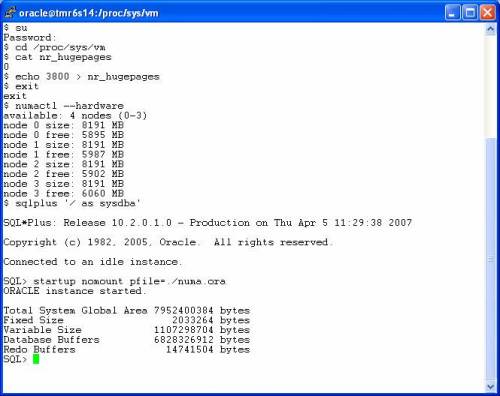
The following is a screen shot of a session where I allocated 3800 2MB hugepages after the system was booted by echoing that value into /proc/sys/vm/nr_hugepages. Notice that unlike Cyclops, the pages are allocated for Oracle’s future use in a more distributed fashion from the various memory banks. I then booted Oracle. No Cyclops here.
hugepages

Interleaving NUMA Memory Allocation
The numactl(8) command supports the notion of pushing memory allocation preferences down to its children. Until such time as the Linux port of Oracle is NUMA-aware internally—as was done in the Sequent DYNIX/ptx, SGI, DG, and to a lesser degree the Solaris Oracle10g port with MPO—the best hopes for efficient memory usage on a commodity NUMA system is to interleave the placement of shared memory via numactl(8). With the SGA allocated in this fashion on a 4-socket NUMA system, Oracle’s memory accesses for the variable and buffer pool components will have locality of up to 25%–generally speaking. Yes, I’m sure some session could go crazy with logical reads of 2 buffers 20,000 times per second or some pathological situation, but I am trying to cover the topic in more general terms. You might wonder how this differs from SUMA/SOMA though.

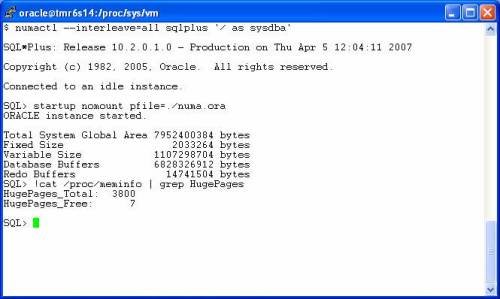
With SUMA, all memory is interleaved. That means even the NUMA-aware Linux 2.6 kernel cannot exploit the hardware architecture by allocating structures with respect to the memory hierarchies. That is a pure waste. Moreover, with SUMA, 100% of your Oracle memory accesses will hit interleaved memory. That includes PGA. In contrast, properly allocated NUMA-interleaved hugepages results in fairness in the SGA placement, but allocation in the PGA (heap) and stack for the sessions are 100% local memory! That is a good thing. In the following screen shot I coupled numactl(8) memory interleaving with hugepages.
interleave

Validated Oracle Configuration
As I pointed out, this Oracle Validated Configuration listing for Proliant recommends turning off NUMA. Now that I’m an HP employee, I’ll have to pursue that a bit because I don’t agree with it at all. You’ll see why when I post my performance measurements contrasting NUMA (with interleave hugepages) to SUMA/SOMA. Look at that Validated Configuration web page closely and you’ll see a recommendation to allow Oracle to use hugepages by tuning /etc/security/limits.conf, but neither allocation of hugepages from the grub boot line nor via the sysctl.conf file!

Could it be that the recommendations in this Validated Configuration were a knee-jerk reaction to Cyclops? I’m not much of a betting man, but I’d wager $5.00 that was the case. Like I said, I’m in HP now…I’ll have to see what all that was about.

Up Next
In my next installment, I will provide Oracle measurements contrasting SUMA and NUMA. I know I’ve said this would be the installment with Oracle performance numbers, but I had to lay too much ground work in this post. The mind can only absorb what the seat can endure.

Patent Infringement
For all you folks that hate the concept of software patents, here’s a good one. When my Sequent colleagues and I were working out the OS-requirements to support our NUMA-optimizations of the Oracle 8 port to Sequent’s NUMA-Q system, we knew early on we’d need a very rich set of enhancements to shmget() for memory region placement. So we specified the requirements to our OS developers. Lo and behold U.S. Patent 6,505,286 plopped out. So, for extra credit, can someone explain to me how the Linux 2.6 libnuma call numa_alloc_onnode() (described here) is not in complete violation of that patent? Hmmm…

Now for a real taste of NUMA-Oracle history, read the following: Sequent_NUMA_Oracle8i

Oracle11g New Features Look Like Good Stuff. Not Just a World Domination Play.

I feel fortunate to be one of 350 people invited to Oracle HQ this week for the Xtreme PTS: The Total Oracle Partner Technology Connection. This is a week long 11g briefing, technical deep dive and hands-on event hosted by Oracle’s Platform Technology Solutions group.

I’ve been involved with pre-release Oracle technology in one fashion or another with every release since 5.1.17 so I’ve been to this type of event several times. Over the years these events have been sort of “This is our software, with it we shall dominate the world.” That was not the case at this event. The presentations have been very good, focused on the technology and honestly a pleasure to attend. Andy Mendelsohn gave the first key note presentation covering 11g new features. I have to admit I was curious what sort of war drum the 11g new features presentation would sound like. Would I hear, “We are Linux” or “Microsoft Sucks?”

As soon as Andy started to speak, I set my stop watch. I wanted to time how long it would take for the word Linux to pop up. I was pleasantly surprised that the first 21 minutes of the presentation consisted of a good coverage of the new features with complete lack of any “World Dominance” sort of mantra. At 22 minutes, the word Linux appeared right next to Windows in the context of provisioning! See, I don’t think we really want to hear all this “Rule the world with Linux” sort of stuff. After all, the majority of Oracle customers are running their business with Oracle on Unix systems primarily, Windows just below that and then Linux. I’m not bashing Linux, but come on, it is just an OS. We like Oracle—The Database, the platform. No need for Linux religion really.

Richard Sarwal followed with an update on Enterprise Manager. I’ve known Richard since the mid-90s. What I learned from his presentation is that EM is getting more and more focus at Oracle. I’m glad because as it stabilizes it appears to me more and more crucial in the grand scheme of operations over all. I have to admit that I have not kept myself up to date with some of the provisioning and patch management capabilities of EM. Small awakenings like that are why I like to attend these types of events.

Near the end of the day yesterday I spent about an hour and a half briefing the Sr. Director in charge of VOS development in Server Technologies on some testing I’m doing in our labs. One of his engineers that I’ve known, and held in the highest regard, since the mid-90s was there as well. After the meeting she told me she reads my blog. She didn’t chew me out about the content. I was happy.

Oracle versus SQL Server
I’ve pointed out many times on this blog that I am not a Microsoft-basher. I do have one thing to say, however. The more I see about 11g combined with the February SE licensing (as I discussed in this blog entry) change, Oracle is going to put the hurt on SQL Server they way they did Informix, Sybase and Ingres. And for those of you who can’t remember those wars, they were bloody.

World Dominance
OK, so I harp on that one a bit too much. It isn’t that I don’t think Oracle should pursue world dominance; it’s just that I don’t want to constantly hear about it. Too much preaching to the converted gets tiring. Look, if Oracle doesn’t remain dominant in the market they won’t be there to support our deployments. None of us would benefit from Oracle suffering in the market.  But world dominance?

It’s OK To Blame the “Storage.” Oracle Problems When “Storage” is “Just Fine”

“It’s not the storage.” Now that is a famous quote. I hear about it all the time. Some bizarre Oracle problems crop up and the DBA team do all the analysis they possibly can and then start talking to the System Administration and eventually, the Storage Administration folks. Let me tell you a tale…

I had a fully functional 4 node Oracle10gR2 RAC cluster running on RHEL4 x86_64. Everything was just fine, until Wednesday this week. The 30+ hours that ensued were quite interesting—because of how many different teams of people were involved. I’d like to share the strangest set of Oracle failures that turned out to be “storage related.” Why the quotes?

Storage Starts When Oracle Makes an I/O Call
That is my opinion and it always has been. As far as the Oracle server is concerned, everything “downwind” of a physical I/O (e.g., db file sequential read, direct path write, log write parallel write, db file scattered read, CF read, etc) is storage related—generically speaking. Some of that is in the I/O library (user mode), some in the Kernel I/O stack, and more in the I/O adapter firmware, storage array firmware and all the hardware along the way of course. So why did my database spend about an entire day down when there were “no storage errors?” Ever hear that from the Storage Group in your IT shop? Sure you have. The problems my database had were not because blocks of data where failing to hit their rightful spot on some little round, brown spinning thing somewhere. No, this “storage problem” was up-wind from that point.

Diagnosis
Yes, the best way to get to the bottom of a problem is to ask 3 questions:

  1. Has this ever worked
  2. When did it stop working
  3. What changed

If nothing changed in my situation, that database would have most likely happily continued to run. But we were changing a lot of things—I admit. We were testing the I/O stack comparing RHEL4 kernel versions 2.6.9-34 and 2.6.9-42. The following problems are not typical of “I/O related issues”:

Wed Mar 28 19:08:00 2007
Errors in file /u01/app/oracle/admin/PROD/udump/prod1_ora_7140.trc:
ORA-00600: internal error code, arguments: [2116], [900], [], [], [], [], [], []
ORA-00600: internal error code, arguments: [3708], [910], [], [], [], [], [], []
Wed Mar 28 19:08:05 2007
Trace dumping is performing id=[cdmp_20070328190805]
Wed Mar 28 19:08:38 2007
Errors in file /u01/app/oracle/admin/PROD/bdump/prod1_ckpt_7018.trc:
ORA-00600: internal error code, arguments: [2103], [0], [4], [1], [900], [], [], []

Well, OK, CF Enqueue timeout could be I/O related, and ORA-00600 [3708] is not that uncommon, but 2116 is not very common. The point is that I had no I/O errors anywhere. The problem persisted:

Thu Mar 29 10:36:20 2007
GES: Potential blocker (pid=6870) on resource DM-0x0-0x1;
enqueue info in file /u01/app/oracle/admin/PROD/bdump/prod1_lmd0_6735.trc and DIAG trace file
Thu Mar 29 10:42:06 2007
Errors in file /u01/app/oracle/admin/PROD/udump/prod1_ora_6870.trc:
ORA-00600: internal error code, arguments: [2116], [900], [], [], [], [], [], []

$ more /u01/app/oracle/admin/PROD/udump/prod1_ora_6870.trc
*** 2007-03-29 10:13:11.558
Dumping diagnostic information for CKPT:
OS pid = 6776
loadavg : 1.34 0.97 0.54
memory info: free memory = 0.00M
swap info: free = 0.00M alloc = 0.00M total = 0.00M
F S UID PID PPID C PRI NI ADDR SZ WCHAN STIME TTY TIME CMD
0 D oracle 6776 1 0 75 0 – 129285 wait_f 09:51 ? 00:00:00 ora_ckpt_PROD1
(no debugging symbols found)
Using host libthread_db library “/lib64/tls/libthread_db.so.1”.
Attaching to program: /proc/6776/exe, process 6776
skgpgpstack: fgets() timed out after 60 seconds
*** 2007-03-29 10:14:45.135
*** 2007-03-29 10:14:55.139
Waited for detached process: CKPT for 310 seconds:

This cluster was quite ill as should be apparent. But is it apparent that “Storage” is the problem?

What is “Storage” Again?
The moral of this story is to remember that I/O starts when Oracle makes a physical I/O call. This problem turned out to be an accidental association of .34 kernel modules getting used by a .42 kernel. Most things worked just fine—but I sure could not boot my Oracle database.

Once the right kernel modules were sorted out, the instances booted just fine and it started chugging along:

SQL> @io.sql

READS READMB WRITES WRITEMB
———- ———- ———- ———-
6648 41.6289063 97259 403.9375

SQL> list
1 select sum(PHYRDS) reads,sum(PHYBLKRD * 4 )/1024 readMB,
2 sum(PHYWRTS) writes,sum(PHYBLKWRT * 4 )/1024 writeMB
3 from dba_data_files,gv$filestat
4* where dba_data_files.file_id = gv$filestat.file#

The Moral
This blog entry won’t be life changing for anyone—except perhaps someone who is googling for ORA-0600 errors that start popping up “out of nowhere” on a database that has otherwise been quite healthy. Or perhaps even, someone that suspects they have a “storage problem”, but the blocks of data seem to be getting to disk just fine as far as the Storage Group can tell.

I hope my viewpoint about where “Storage” begins resonates with readers though.

Oracle on Virtual Machines. Going Fishing? Intel “Nehalem” Xeon Quad-Core with CSI Floats!

CRN.com has coverage of the Xeon “Penryn” processor and some info about the micro-architecture change that will following in 2008 with the “Nehalem” processor. I think the following is an astounding comment:

Meanwhile, Intel is also preparing its next-generation Nehalem platform, which represents the company’s most significant shift in system architecture since the Pentium Pro debuted in 1996, Gelsinger said.

If you remember the P6 Orion chipset with the Pentium Pro, you’ll recall that it was Intel’s first MCM with 4 Pentium processors. It offered 48 bit memory support (kernel address space), 3 cycle shared L2 cache, and was quite the leap over the Pentium. The article states that the off-chip memory controller will be gone (good) and the interconnect (CSI) will be more like AMD HyperTransport. I think that means a bit of a NUMA feel, but I’m not sure yet. The architecture of Nehalem will support up to 8 cores as well.

What Does This Have To Do With Oracle
These are quad core processors that are going to pack a very significant punch—much more so than the AMD Barcelona processor expected later this year. That means single socket, quad core servers with more power than most 4 socket systems today. So if you have, say, a Proliant DL585 (great box) with idle cycles, you will likely have a lot of idle cycles when you refresh with these servers. That means virtualization—get use to it. The article hints towards 32nm processors in the 2010 timeframe. My oh my.

Where and What is a Nehalem, Really?
It is a North American Indian tribe. There is also a river about 40 miles from where I live and it is, in fact, precisely what Intel named this processor after. Intel has named other processors after rivers in the Pacific Northwest region of the states in the past (e.g., Willamette). I’ve been fishing the Nehalem for many, many years. I’m told blogs are better with photos, so here goes.

I’m sure the concept of fishing will wound the tender sentiment of at least a few readers. I’m sorry. You can’t make everyone happy, but I’ll throw a bone. The main species we fish for in the Nehalem is Steelhead which is an anadromous salmonid related to trout. Basically, it is a trout that lives in salt water but spawns in fresh water. Unlike true salmon, it can repeat that cycle. For that reason, game management in my home state enforce a great deal of “catch and release” and artificial bait regulations. That is in fact what I was doing when I caught the “Nehalem Bright”, as they are called, in the following photo. Caught, photographed and placed gently back into the water.

Nehalem_Brite


DISCLAIMER

I work for Amazon Web Services. The opinions I share in this blog are my own. I'm *not* communicating as a spokesperson for Amazon. In other words, I work at Amazon, but this is my own opinion.

Enter your email address to follow this blog and receive notifications of new posts by email.

Join 819 other subscribers
Oracle ACE Program Status

Click It

website metrics

Fond Memories

Copyright

All content is © Kevin Closson and "Kevin Closson's Blog: Platforms, Databases, and Storage", 2006-2015. Unauthorized use and/or duplication of this material without express and written permission from this blog’s author and/or owner is strictly prohibited. Excerpts and links may be used, provided that full and clear credit is given to Kevin Closson and Kevin Closson's Blog: Platforms, Databases, and Storage with appropriate and specific direction to the original content.